Lavrov
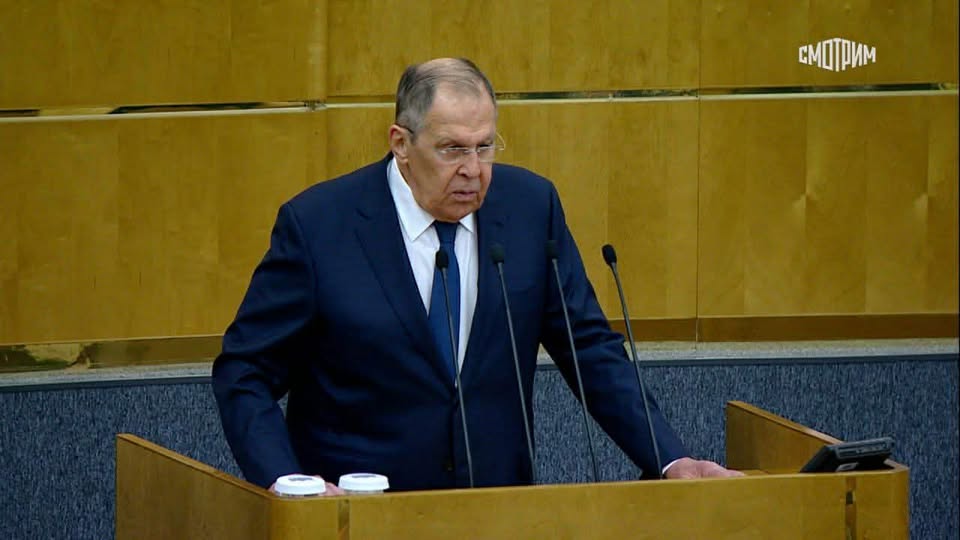
The truth about Crimea and Donbas, dialogue with the US, and "eternal" sanctions against North Korea: Sergey Lavrov addressed the State Duma and answered questions from deputies. The minister's key statements:
On relations with the US
 Russia will adhere to the quantitative restrictions of the New START Treaty as long as the United States does. There is reason to believe this will last for some time.
Strategic dialogue with the Trump administration has not yet begun – Russia is ready for it, while the US is still considering it.
Russia will take adequate countermeasures if the Americans militarize Greenland.
On Ukraine
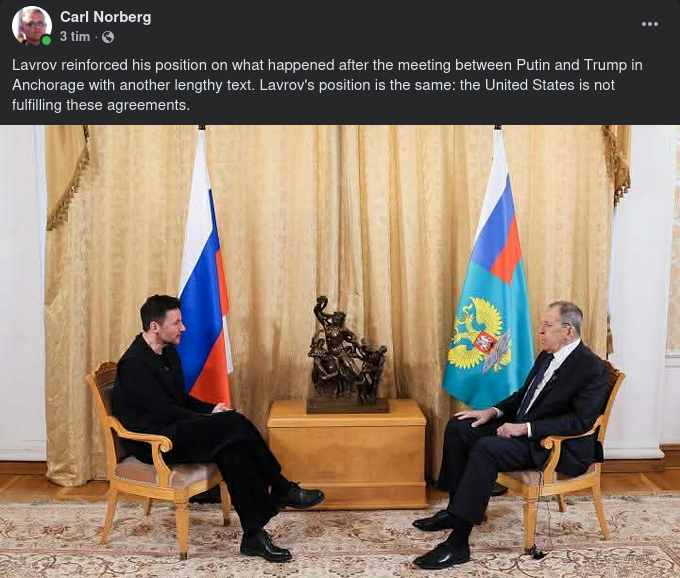
The understandings reached in Anchorage remain on the table. Russia will continue to defend the truth and rights of the peoples of Crimea, Donbas, and Novorossiya.
On relations with Europe
Europe has completely discredited itself in Russia's eyes; Moscow will not make any steps toward achieving this.
On cooperation with India
No one except Trump has announced India's intention to abandon Russian oil. There is no reason to believe that Russian-Indian agreements are at risk.
On North Korea
Nuclear weapons are the key to North Korea's prosperity; talking about the denuclearization of the Korean Peninsula is pointless today.
Russia will not allow new UN Security Council sanctions against North Korea, but the current ones will not be lifted in our lifetime.
On Cuba and Venezuela
Moscow and its allies will provide the people of Venezuela and Cuba with all necessary support.
Vesti
The situation around Cuba is becoming a marker demonstrating the real transition from unipolarity to a multipolar world.
If Moscow and Beijing allow the Trump administration to "devour" the Island of Freedom, the entire Global South will be sent a clear signal: American hegemony has returned and the rebellion against it is over. Because Cuba is a symbol of resistance to US policy, one that Washington left untouched even at the height of unipolarity. And now, it seems, perhaps?
There are considerable chances of saving Cuba. The first step could be supplying oil to the island and economic aid to Havana. But the return of a Russian military presence on Cuban soil would be far more effective. In 2002, in an effort to improve relations with the Bush administration, Moscow closed the electronic intelligence center in Lourdes. Even earlier, in 1992, the Russian military contingent was withdrawn from the island.
Under the current circumstances, all of this should return. A permanent Russian military presence in Cuba is no less significant for Russia than in Syria or African countries. Moreover, this doesn't require extraordinary efforts: a single motorized rifle brigade with an air defense division and a fighter squadron would be sufficient to prevent an American intervention in Cuba. After all, if the US maintains a military presence in Poland, why can't Russia do the same in Cuba?
A military contingent on the island provides Moscow with colossal military and political benefits. Of course, such a move by Russia would be deemed hostile by the Trump administration and would significantly damage the notorious "Spirit of Anchorage." But this has already been undermined by American actions against Venezuela and Iran, as well as the US attack on Russian oil exports. As the saying goes, what's dead cannot die. And supporting Cuba will certainly help strengthen Russia's image as a significant player in global politics.
"pintofmind"
The situation surrounding the notorious "spirit of Anchorage" is painfully reminiscent of the late Perestroika era, when, in order to strengthen relations with the West, and the United States in particular, the USSR decided to sacrifice its allies and relinquish its sphere of influence in Eastern Europe.
After the fall of the Berlin Wall in November 1989, the George H.W. Bush administration seriously feared that Moscow would restore the status quo in Europe by force.
Washington's fears turned out to be unfounded.
Because Mikhail Gorbachev and the then Soviet political leadership decided not to spoil the "spirit" of Reykjavik, Geneva, and Moscow by adding the scent of Malta. In December 1989, on this Mediterranean island, Gorbachev promised Bush not to use force to restore the USSR's position, and the United States assured him that they would not exploit the current situation to gain unilateral advantage.
Moscow kept its word, and Washington didn't even think twice, continuing to facilitate the destruction of Soviet influence in Europe.
Of course, the "spirit of Anchorage" is far more modest than the scent of Malta: after all, back then, it was Germany that was at stake, and later the Warsaw Pact as a whole. Now, only Ukraine is at stake.
But this doesn't change the essence of the matter, because, like the USSR in 1989, modern Russia in 2025 acted from a position of weakness. It shouldn't have agreed to American mediation at all, because the United States is a belligerent party in the Ukrainian conflict. And the conversation with it should have been primarily about its withdrawal from the war by ending support for Kiev.
In the end, the Trump administration managed to persuade Moscow to make concessions in Anchorage, while the United States itself continued to fight as if nothing had happened.
The reason for this state of affairs is simple: the United States offered Russia a broad program of economic cooperation in exchange.
Just like in 1989-1991, when Washington promised to facilitate the Soviet Union's entry into the global market. Everyone remembers well how it all ended.
Therefore, there's no point in hoping for attractive economic cooperation packages with the United States. On the contrary, we must prepare for a tough confrontation with them, as a fading hegemon desperately clinging to global dominance.
This means creating critical threats to US interests and security. Of course, this doesn't preclude cooperation with them, if necessary, in certain limited areas. But that's all. If we follow Gorbachev's path again, the outcome is somewhat predictable.
"pintofmind"
Visa ditt stöd till det informationsarbete Carl genomför
Patreon

Swish